
Jason Psarakis left an international career to build his own model of sustainable tourism in Greece
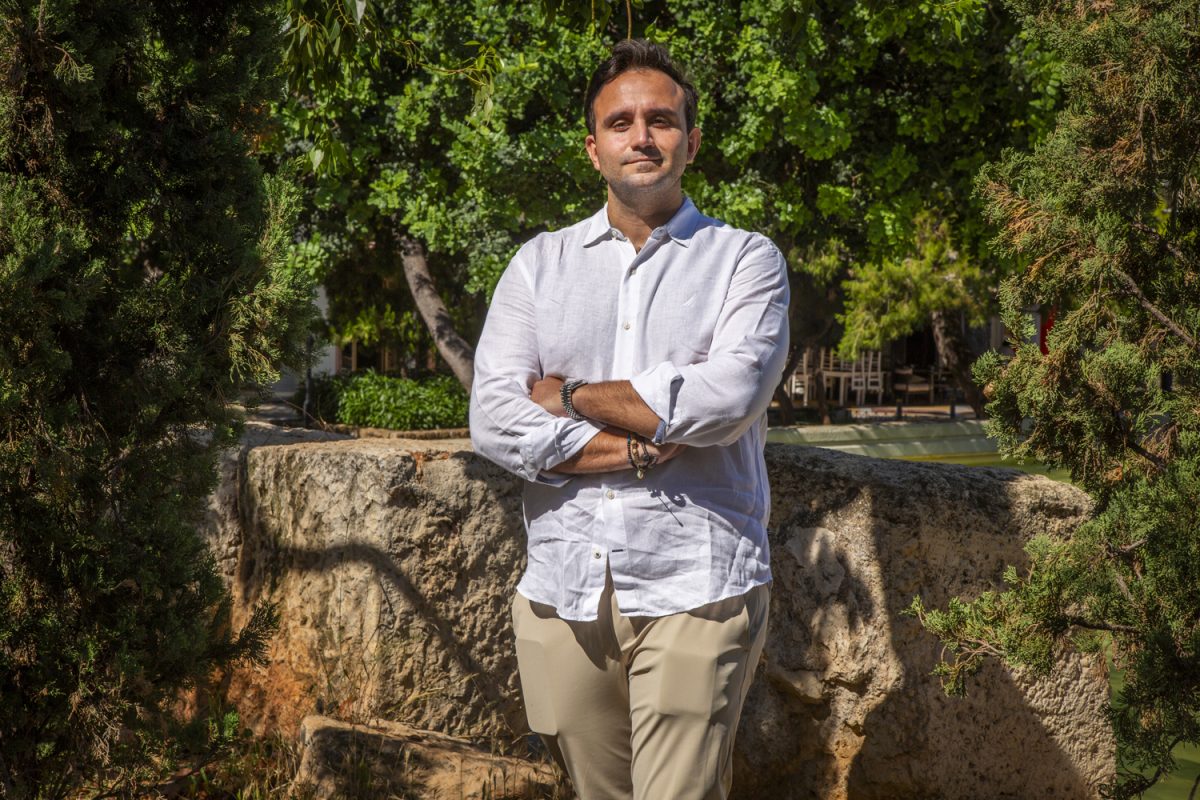
He grew up between Kallithea and Nea Smyrni, studied at the National Technical University of Athens, and in 2018 left Greece without looking back. Seven years later, Jason Psarakis, having traded a life in Geneva for Athens, created the first Greek booking platform that turns sustainable tourism into reality – and he explains to NouPou what Zero Stars Hotels is and why sustainable rooms are the future of hospitality.

Zero Stars Hotels introduces a new way of booking a hotel: by choosing which amenities you want and which you don’t, thereby reducing not only the cost but also the energy footprint of your stay. With innovations such as Zero and Sustainable Rooms, the platform gives visitors both control and incentive for more responsible choices, while also providing hoteliers with the tools for more sustainable operations.
NouPou met with one of the two founders of the platform, Jason Psarakis, who grew up in Nea Smyrni and later built a career in major multinationals abroad, such as the oil company Exxon Mobil and consumer goods company Procter & Gamble. He left Brussels and Geneva and returned to Greece with the goal of bringing real change to the way we travel.
Together with his partner, Tasos Xetritis, they decided to take their own independent step. But how was the idea of Zero Stars Hotels born, what does a “zero room” really mean, and why does he believe that Greece can lead the way in sustainable tourism in Europe?
Mr. Psarakis, I’d like to start with the name. How did “Zero Stars Hotels” come about?
I was sure you would begin the interview with that question! Zero Stars is related to the field of zero carbon emissions (zero emissions) and how we can minimize the environmental footprint through our activity. At the same time, the name “hides” something even more important: a hotel can have from “0” up to unlimited stars, thanks to the personalized service offered by the platform. So a room can start at “0” and reach “100,” even in a five-star hotel in terms of in-room services and amenities. The usual way hotels are rated with stars is that specific conditions must be met, for example whether it has a swimming pool, the square footage of the room, or other such requirements.
What we aim to do is to move away from that philosophy. Often some hoteliers ask us: “why should I become a ‘zero stars hotel’?” The answer we give is that guests can start from zero and “build” their room exactly as they want it. There is no greater luxury than having exactly the things one expects in their room.
We offer an online hotel booking platform that introduces two categories of rooms: for the same room one can book it either as a sustainable room or as a zero room. In the sustainable room the hotelier has preselected 2–3 amenities to remove, and for each removal the final room rate decreases accordingly. For example, a guest may not need daily towel changes or the small bottles of shampoo and shower gel in the bathroom. The guest therefore sees the price drop and is incentivized to stay in a sustainable accommodation, while at the same time having the ability to see the exact environmental impact for each additional amenity they choose.
So this is essentially a patented invention related to the application’s algorithm, which calculates the environmental impact of each additional amenity?
In essence, we have patented the algorithm that accurately calculates environmental impact. That means someone can choose a room without a television and then add amenities. For each step where they add amenities, they have the ability to see by how many kilos of carbon dioxide the footprint is reduced when they remove things.
How easy is it to apply such a booking model in Greece, where investments of many millions are being made in ultra-luxury hotel infrastructure and accommodations with multiple amenities, when in your case we are talking about removing those amenities?
You should know that 90% of the revenue in four- or five-star hotels comes from international guests. Eighty-five percent of those guests state that they want to travel more sustainably. And these visitors understand what it means not to have towels changed daily or not to have their room cleaned every day. At the same time, hoteliers have every reason to care, since under European legislation hotels must reduce carbon emissions by 30% by 2030. One way to achieve this is to buy certificates stating that the hotel has met the sustainability target.
We, on the other hand, want to make Greece the leading destination for sustainability at a European level, based on real figures that show exactly how much carbon emissions have been reduced. We can reduce up to 20% of carbon emissions through the hotel sector alone.
How are the commissions you collect from hoteliers structured, and what differentiates you from major competing booking platforms?
The commission is charged per booking. So, if a guest books a sustainable room, the hotel will pay just a 5% commission. At the moment the minimum commission with competitors is 15%. If, on the other hand, the room is not sustainable but categorized as a “zero room,” the commission for the hotelier is 10%. And if the room is listed as a room like on other platforms, the commission is 15%, because we don’t believe we should provide any incentive for those rooms. These commission rates are sustainable for us.
So, what differentiates you from booking or other similar platforms?
Our main characteristic is that we only feature hotels and not private residences as other platforms do. A second factor is that we work alongside hoteliers rather than against them. It is telling that the two largest platforms are facing mass class actions because they exploited their dominant market position to bring in more bookings.
When will you officially launch?
Our goal is to begin some campaigns aimed at Greek consumers in October, and afterwards we will focus on international markets from 2026 onwards.
Who started this effort and why?
It all began together with Tasos Xetritis at Easter 2022. Tasos lives permanently in Samos, and I happened to visit the island after many years. He had the idea of creating a platform called “Zero Stars Hotels” and was thinking about how to implement it, by creating custom-made rooms in hotels. For the next four months we went through the process of figuring out exactly what we wanted to create. We put aside the initial idea, because it required a lot of capital to implement. However, we decided it would be effective to sign direct contracts with hotels, something that hadn’t happened since Expedia entered Greece 15 years ago. To this, we added the element of sustainability.
What guarantees that a major competing platform cannot copy you? Something you started in 2022 and worked hard for, while a large platform with liquidity, know-how, and staff could do it in just a few months.
That is the reason why, although we conceived of what we would do in 2022, we are launching in 2025. On one hand, the carbon emissions calculation algorithm is nationally patented, as it was developed by our team with a patent. We have already applied for a European patent as well. And thanks to the protection, we entered into a process of requesting exclusive collaborations with hoteliers. So the “zero” and “sustainable” rooms are offered exclusively, and from our side we provide the usage rights to our patent, allowing hotels to declare that they have reduced carbon emissions with measurable data. In addition, hotels benefit from the lowest commissions in the market.
Did more people join the founding team along the way?
Looking for people who could further support our effort, we approached Thomas Angelidis, a childhood friend of mine. We grew up together and followed parallel paths, as he also worked in oil companies. With his help we brought scientific expertise into calculating the carbon footprint of our platform.
Later on, Dimitris Saragas from Rhodes joined, who had worked with Tasos in marketing for hotels. Finally, Phoebos Andriotis, with extensive experience in technology, helped us develop the platform’s technology. An individual investor also came on board.
You grew up in Nea Smyrni. What do you remember from your childhood?
My home was in Kallithea, but I grew up in Nea Smyrni as I went to school at Leonteios, while my grandmother lived on Megalou Alexandrou Street. I was part of the Panionios swimming team, and I spent my whole life there until the moment I left for abroad at 23.
How did you decide to leave Greece?
I left in 2018, when I graduated from the National Technical University of Athens as an engineer and went on to the London School of Economics to study strategic management. I really wanted to leave Greece at a time when the country was in the midst of crisis. And I left with great joy. I was sure I would never return. I had a farewell party and said then that it would be the last time I saw the people who were invited. I couldn’t see how things would change in Greece, and I had nothing keeping me here. I always had in mind that I would work for major companies, which I did.
But eventually came the moment of return. Again, specific circumstances led you back.
As I went to London to study, I had one of the best years of my life as a student. It was also a difficult time professionally because companies weren’t hiring European citizens due to Brexit. So I ended up in Brussels, working as a business analyst at Exxon Mobil. Then Covid came. And I thought, career is good, but it’s even better to be close to home. I was alone in Brussels during the pandemic. As I didn’t see professional prospects there, I decided to leave and work for Procter & Gamble in Geneva. It was my dream job. However, the market “turned.” From negative oil prices due to Covid and the Ukraine–Russia conflict, natural gas prices skyrocketed, reaching €300 per megawatt-hour. That was another big lesson, in how to negotiate contracts and face crisis periods. From Geneva, the distance to Greece was only 2.5 hours, which made me feel closer and eventually led me to make the decision to return.