
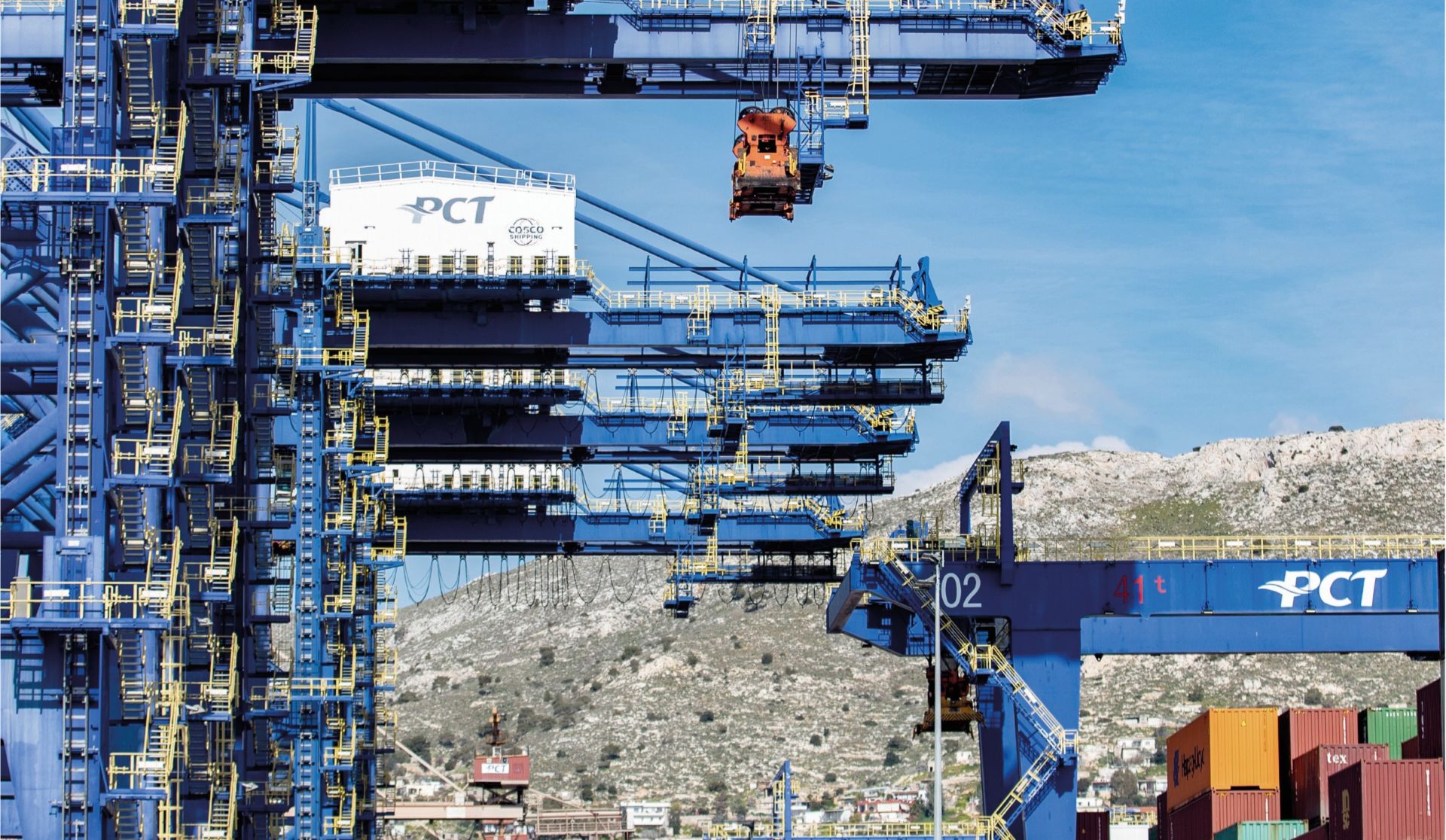

Piraeus Container Terminal: The new role of ports in the era of green transition
Investing in a port development model focused on resilience, sustainability and long-term value.
- 01/10/2026 17:58
The debate on sustainability usually focuses on energy-generating companies, industrial complexes or financial markets. Much less often, it turns to the infrastructure that allows the global economy to operate every day.
And yet, few sectors are today as close to the great challenges of our time as ports.
Energy transition, the decarbonization of shipping, the resilience of supply chains, the digitalization of transport and the growing need for responsible corporate governance all have a single meeting point: modern port ecosystems.
For decades, the success of a port was measured in terms of capacity, speed, reliability and connectivity. Today, these criteria remain necessary, but they are no longer sufficient. Climate crisis, geopolitical upheavals, energy uncertainty and increasing transparency demands are redefining the role of ports as critical infrastructures of the economy.
Piraeus Container Terminal (PCT), a subsidiary of COSCO SHIPPING Ports, and operator of Piers II and III of Piraeus Container Terminal, is right at the heart of this transition. With investments exceeding €600 million since the start of its operations, the company has contributed decisively to transforming Piraeus into one of the most important transit hubs in Europe. Today, however, what is at stake is not just growth. It is how this growth can remain sustainable in an environment that is changing faster than ever.
From logistics hub to energy hub
The decarbonization of shipping is one of the greatest challenges of the global economy. The discussion often focuses on ships and fuels of the future. In reality, however, this transition cannot be achieved without the involvement of ports.
Modern container terminals are gradually evolving into energy platforms, where electromobility, energy efficiency, digital technologies and new infrastructures make up a single transition ecosystem.
PCT’s strategy reflects exactly this logic. The full electrification of the terminal’s core equipment, the continuous upgrade of energy monitoring systems, the development of projects that enable further reduction of the carbon footprint in the future and the preparation for the next generation of port infrastructure are part of a broader plan that links operational efficiency with environmental performance.
These are not just technical interventions; they are investments that affect the competitiveness, operating costs and the ability of a port to meet the demands of the next decade.
Synchronization as the biggest challenge
The transition to a lower carbon economy is not a single organization’s effort. Shipping is investing in new fuels. Energy providers are developing new networks. Logistics companies are accelerating their digital transformation. Ports are upgrading their infrastructure.
The critical question is whether all of this can evolve at a common pace.
For PCT, sustainability is directly linked to this need for coordination. The development of the ports of the future requires cooperation at the supply chain level, joint investment planning and greater alignment among shipping, ports and the energy sector. The challenge is not only technological but also systemic.
The human factor as a strategic asset
At the same time, sustainability in ports is not only about infrastructure.
As the industry becomes more automated, digital and technologically complex, human resources become even more important. The development of new skills, safety, lifelong learning and adaptability are now factors of operational resilience.
PCT treats human resource management as a long-term and systematic investment. Continuous training, strengthening the safety culture and creating a modern work environment are key priorities, as the success of any technological transformation depends primarily on the people who implement it.
The value of social connection
Major ports do not operate in isolation from their environment. They are an integral part of local economies and societies.
The social dimension of sustainability is becoming increasingly important. PCT, through a multi-year support program exceeding €850,000, invests in training, supporting local initiatives, strengthening social cohesion and maintaining an open dialogue with social partners. These are elements that directly affect the long-term sustainability of an infrastructure.
The organization’s experience confirms that social acceptance is not a complementary element of development. It is a prerequisite for its maintenance.
Beyond compliance
For organizations that manage critical infrastructure, sustainability is no longer a matter of reporting indicators or regulatory compliance. It is a strategic management tool. A mechanism that allows for early identification of risks, improved decision-making and the creation of more resilient organizations.
In this context, next-generation ports will not be evaluated only by the volume of cargo that they handle. They will be evaluated by their ability to function as hubs of connectivity, energy, technology and social value.
The case of PCT shows that this transition is not a future scenario. It has already begun.
Published in “White Paper: The Greater Riviera”, NouPou Media’s special edition spotlighting the future of coastal Attica.